CONTENT TRACKING SYSTEM
One Number for the Health of Your Document Repository
What the AITS Content Tracking System (CTS) is, what it does, and how it works.
If you pulled a thousand documents at random from your repository, what percentage would be current, correctly classified, properly secured and free of duplicates?
Most organizations cannot say. That is the problem: not that the records are known to be poor, but that their condition is not known at all. The AITS Content Tracking System (CTS) was built to answer that question. Why? So that when you put AI applications on top of your repository, you do not get confident answers that are wrong.
The stakes are high. Gartner predicts that through 2026, organizations will abandon 60% of AI projects unsupported by AI-ready data.
Source: Gartner, “Lack of AI-Ready Data Puts AI Projects at Risk”, February 26, 2025.
What CTS is
CTS gives an executive one number. The CTS score is a composite index of KPIs that tells the health of a document repository.
At 97.8%, you know your repository is sound, and you can say so with confidence in any room. At 64%, there is work to do, and the breakdown behind the score shows exactly what it is.
You choose what healthy means. The score is built from weighted KPIs that you and your managers select. AITS recommends a proven starting set across eight areas: content, structure, metadata, search, data quality, security, governance and AI readiness. You add to it, drop from it or change the weights as your priorities change.
CTS works with the repository you already have. It does not replace your document management system.
What CTS does
BI charts and reports show you the data. CTS uses AI and machine learning to tell you what it means.
- It measures. A health check establishes where the repository stands today, checking every document and record, not a sample.
- It explains. The breakdown shows which KPIs are pulling the score down, and by how much.
- It recommends action. You get a prioritized list of what to fix first, with the gain each fix is worth.
- It keeps watching. The score stays current around the clock, as every document and data record is added.
The point is to find an issue before it becomes a failed search, a wrong answer from an AI assistant, or a claim. A poorly described record, a duplicate or a missing access status costs little to fix early and a great deal to fix late.
How it works
- Your official repository is never touched. CTS runs on a secure replica hosted in-country. Nothing destructive can happen to the original, and the work can always be compared against it.
- It learns from your staff. The AI is trained on your own records. When staff confirm, correct or dismiss a finding, that decision trains the model, so the alerts get sharper and fewer need review.
- You decide how much it does. Every type of issue starts with CTS recommending and a person acting. When you are satisfied it handles a type correctly, you can let it prepare the fix for approval, and later resolve that type itself. Every action is logged and reversible.
- People stay in charge. CTS takes the repetitive work off their desks and leaves them the review, the exceptions and the decisions.
The two improvements compound. Better records make the AI more accurate, and a more accurate AI finds the next issue sooner. That matters most for any organization planning to put AI on top of its documents, because AI is only as reliable as the records it works from.
See it for yourself
We ran CTS on real public records, so you can see a real score and what is behind it:
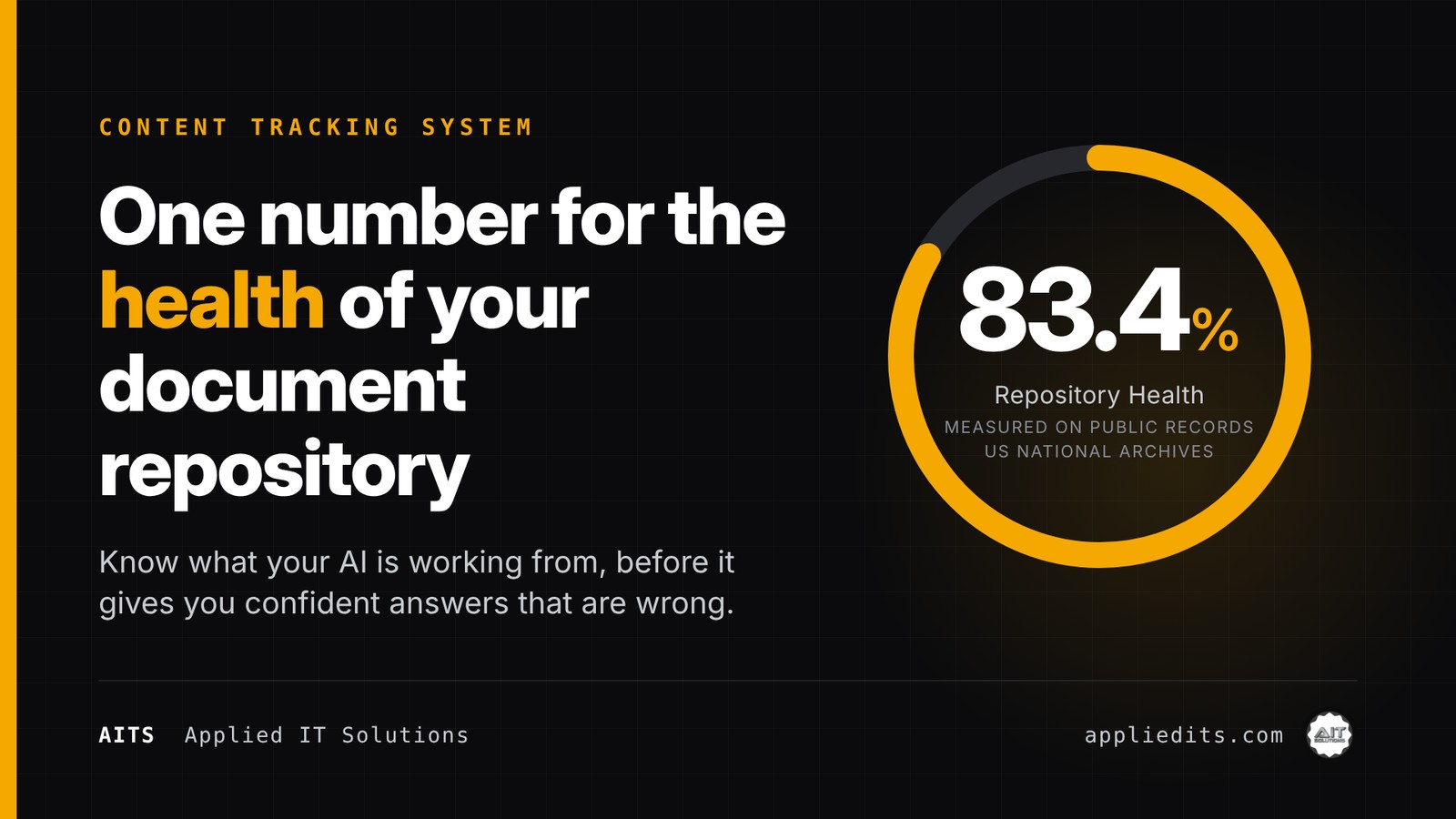
- US National Archives: We pulled a sample set of Land title documents from the public record and were surprised to see it scored only 83.7%. Health report · CTS dashboard
- The World Bank: We pulled a sample set of Loans and Loan agreements from the public record and saw that it was scored at 89.0%. Health report · CTS dashboard
Each CTS run has a health report with the score, the reasons it is not 100%, and the actions that would raise it.
To estimate the health of your own repository, the Repository Health Self-Assessment is a good place to start. It takes about five minutes.
If you pulled a thousand documents at random from your repository, what percentage would be current, correctly classified, properly secured and free of duplicates? What would your number be?
These scores were measured from published records, against KPIs AITS chose for the demonstration. The pages are not endorsed by, or connected with, the US National Archives or the World Bank.
Find out your repository health
A Repository Health Check gives an executive a scored baseline for their own content, the detail behind it, and a prioritized list of what to do next.
Contact AITS to book a Repository Health Check info@appliedits.comON THE AITS WEBSITE
Repository Health Self-Assessment: Sixteen questions and an estimate of your own score.
Repository Health Check: How the health check and monitoring work.
Sample Health Report: What an executive receives.
Solution Brief: Is Your Repository Ready for AI?: The Repository Health Check in two pages.
ABOUT AITS
Applied IT Solutions (AITS) is a Toronto-based consultancy founded in 2008 and led by its principal consultant. It advises government and Fortune 500 organizations on artificial intelligence, enterprise data strategy, document and records management, and business process improvement, with one aim: deriving tangible business value from the application of information technology. Most engagements are delivered end to end by the principal, from requirements gathering through solution design and delivery to train-the-trainer and hand-off to the client's own team. For larger projects, AITS brings in experienced consultants it works with regularly. AITS delivers globally. Out of this work, AITS developed the Content Tracking System (CTS), an AI-powered monitor that scores the health of a document repository against the organization's own KPIs.