
Home/Content Tracking System
Content Tracking System (CTS)
One number for the health of your document repository
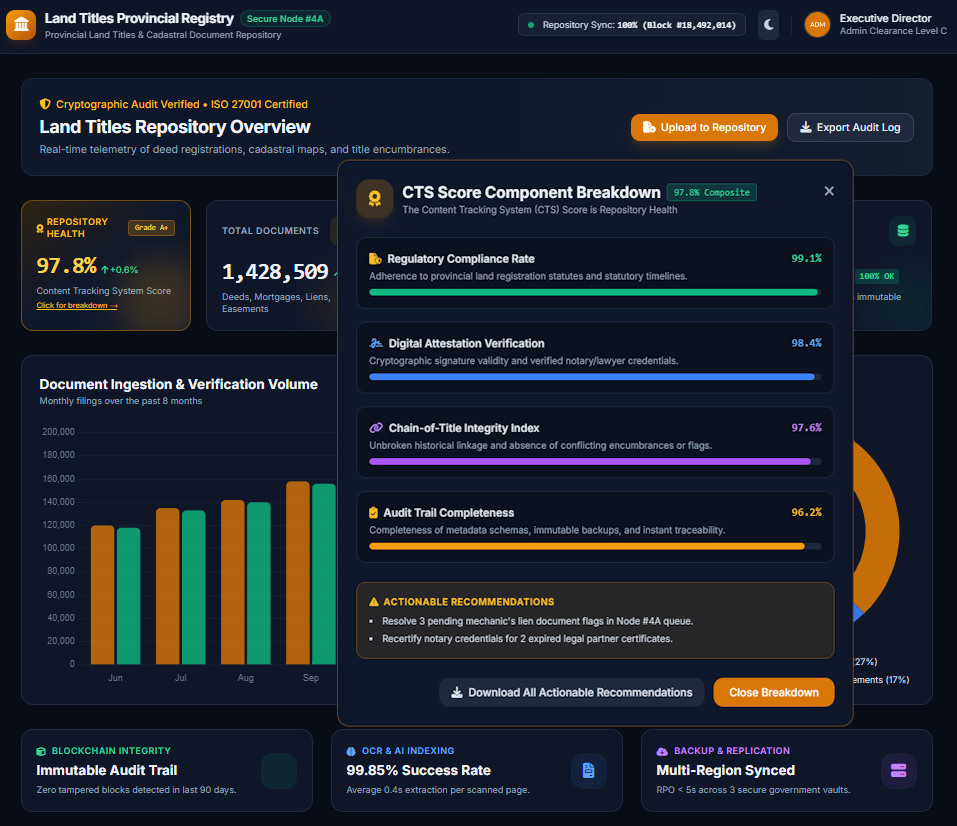
CTS uses AI trained on your own repository to score it against the KPIs you choose, show what is driving the score, and tell you what to fix first. At 96.8% you can say the repository is sound. At 64% there is work to do, and the breakdown shows exactly what it is.
What You Receive
Evidence you can show the board or an auditor
- The score: one composite Repository Health score, built from weighted KPIs that you and your managers select.
- The breakdown: every dimension and KPI behind the score, each one open to see what is pulling it down.
- What to fix first: evidence-based recommendations, ranked by risk and by the gain each would bring.
- A score that stays current: after the first health check, CTS keeps scoring every document as it is added, around the clock.
For example: a contract held in three places with no record of which is the signed one, or a sensitive document stored where too many people can see it. CTS flags it, scores its effect and recommends action, before it becomes a wrong answer or a complaint.
What CTS Measures
Eight dimensions, built from your own KPIs
These eight are the starting set AITS recommends. You add to them, drop from them or change the weights as priorities change. Together they show whether a record has the four characteristics ISO 15489 sets for an authoritative record: authenticity, reliability, integrity and usability.
Content
Document types, volumes, age, duplication and obsolete content.
Structure
Folders, libraries, collections and document types, and the gaps among them.
Metadata
Whether metadata, classifications and identifiers are present, consistent and useful.
Search
What makes information hard to find, retrieve or understand.
Data Quality
Duplicate, incomplete, conflicting or out-of-date information.
Security
Whether access and permissions match the sensitivity of each record.
Governance
Ownership, classification, retention and lifecycle.
AI Readiness
Whether the content is a sound foundation for AI assistants, AI search and automation.
Why It Matters
An AI assistant does not repair a repository. It inherits it.
The problem shows up as an AI assistant giving a wrong answer with full confidence, from a duplicate, an outdated version or a document it should never have seen.
It inherits what it finds
Duplicates, superseded versions and missing metadata all become part of an assistant's answers.
It answers with confidence either way
An AI assistant does not know which of three copies is authoritative, or that a policy has been replaced.
It follows the permissions it is given
If access controls are wrong, an AI assistant will surface a sensitive document to someone who should never see it.
If you pulled a thousand documents at random, what percentage would be current, correctly classified, properly secured and free of duplicates? CTS answers that question for the whole repository, not a sample.
What AI-ready content requires, and how CTS delivers it
| AI-ready content must be… | How CTS delivers it |
|---|---|
| Proven ready, not assumed | The Repository Health Check: one score, the evidence behind it, repeatable |
| Checked continuously | Scores every document as it is added, around the clock |
| Free of known quality problems | The AI Readiness dimension shows how much of the content is ready |
| Described by metadata that drives action | Ranked recommendations; approved fixes applied automatically |
AI assistants also need retrieval pipelines and executive-led governance. AITS delivers those under AI Assistants & Automation.
Consistent with Gartner, February 2025.
Under Your Control
Your official repository is never touched
It works on a replica
Your repository is replicated in a secure cloud environment hosted in-country. CTS's AI is trained and run there, alongside the systems you already have.
Every item is assessed
Content is loaded into the replica in bulk and checked as it arrives, so the score covers the whole repository. Corrections are checked in the replica first; applying them is your decision.
It learns from your staff
Each finding your staff confirm or correct trains CTS's AI, so alerts get sharper. CTS starts by recommending; you decide when it may prepare fixes, or resolve a type of issue itself. Every action is logged and reversible.
CTS corrects repository records (filing, links, duplicates, classification). It never alters the content of a document, and the decisions stay with your people.
Repository Agnostic
Works with the repository you already have
No platform replacement and no particular document management system required. CTS measures enterprise, specialized and file-based repositories, and several at once.
Enterprise content management
Microsoft SharePoint, OpenText (Documentum, Content Server, Extended ECM), IBM FileNet and Content Manager, Hyland OnBase and Alfresco, Nuxeo, Oracle WebCenter, Newgen, SER / Doxis.
Cloud and specialized platforms
Box, Dropbox Business, Google Drive, Egnyte, M-Files, Laserfiche, DocuWare, iManage, NetDocuments, Adobe Experience Manager Assets.
Files and applications
Network file shares and NAS, Azure Blob Storage, Amazon S3, Google Cloud Storage, line-of-business document stores and other legacy environments.
Getting Started
How an engagement works
It begins with a Repository Health Check and can continue as ongoing monitoring. Digitization or migration can be measured the same way, whoever carries it out.
- 1
Discover
Understand the repository and its processes, and agree the KPIs that define a healthy record for you.
- 2
Assess
Replicate the repository, train CTS's AI on it and run the Health Check. The result is the first score and the detail behind it.
- 3
Prioritize
Rank what to fix first by risk and value, including which paper records and legacy systems to deal with first.
- 4
Optimize
Correct, consolidate and monitor continuously. The score shows that each change left the repository better.
Questions and Answers
About CTS and the Repository Health Check
What is the Content Tracking System (CTS)?
CTS is the AITS platform that measures and continuously monitors the health of a document repository. It uses AI trained on your own repository to produce one composite score, built from weighted KPIs you choose, with the breakdown behind it and prioritized recommendations for improvement.
What is a Repository Health Check?
It is the first assessment: one composite Repository Health score for the repository, the breakdown behind it, and a prioritized list of what to fix first. It establishes where the repository stands today, and CTS can then keep the score current as content is added, changed, migrated or removed.
Why does a document repository need a health check before AI assistants use it?
An AI assistant does not repair a repository. It inherits it. Duplicates, superseded versions, missing metadata and wrong permissions all become part of its answers. A health check finds those issues first, so that AI assistants work from content that can be trusted.
How is CTS different from a document management system?
A document management system stores and manages content. CTS measures its condition: it scores the repository against KPIs the business defines, shows the evidence behind the score, and recommends what to fix. It works alongside the systems you already have.
Does CTS change anything in our official repository?
No. CTS runs on a replica of the repository in a secure cloud environment hosted in-country. Corrections are made and checked in the replica first, and applying them to the official repository remains your decision.
Start with the repository you already have
Estimate your score in five minutes, or arrange an executive briefing or a Repository Health Check.