
Home/Solutions/Banking & Lending
Private Sector: Banking & Lending
Know the health of the records behind every loan
CTS gives a lender one Repository Health score for its loan files and how well they agree with the loan book, the breakdown behind it, and a prioritized list of what to fix first. Here it is, measured on real public loans.
The Question
Do your loan files agree with your loan book?
The loan system holds the terms; the document repository holds the evidence. They are created by different people, in different systems, at different times. A file review samples a few hundred loans a year, and problems surface one at a time.
If you pulled a thousand loans at random, for what percentage could you produce the signed agreement, correctly filed, searchable, and agreeing with the loan record on borrower, country and dates?
For example: a loan on the books with no agreement on file, an agreement that names a different country from its loan, or an agreement dated before the loan was approved. CTS flags it, scores its effect and recommends action, before it is found in an audit, a dispute or a sale of the loan.
Why It Matters
A loan is only as enforceable as its documents
A discrepancy between the file and the loan book does not stay in the back office. It follows the loan into every review, report and transaction that relies on it.
Enforceable
The agreement on file is the lender's evidence of the terms. A loan with no agreement on file, or the wrong one, is an unseen risk.
Examined
Auditors, regulators and loan buyers all ask: show me the file. The answer should not depend on which loans they pick.
Long-lived
A loan and its documents are kept for decades, through amendments, restructurings, migrations and changes of staff.
What CTS Measures
What CTS measures in a lending repository
Each dimension is built from KPIs the lender defines and weights, and each rolls up into one composite score. How CTS works: it runs on a replica, never on the official repository, and it learns from your staff under their control.
Content
Does every loan have its agreement on file, and is each agreement filed once, not duplicated?
Structure
Does every agreement carry its project or loan reference, and does that reference match a loan on the books?
Metadata
Are borrower, country, status, dates and loan number recorded for every loan and every agreement?
Search
Does every agreement have searchable text and a title that describes it, not a file name?
Data Quality
Do the agreement and the loan agree on country and loan number, and are the dates in order?
Security
Do access permissions reflect the sensitivity of the file, including borrower information?
Governance
Are each document's classification, disclosure status and version recorded?
AI Readiness
Does the agreement pass every check an AI assistant relies on to answer questions about the loan?
See It on Real Records
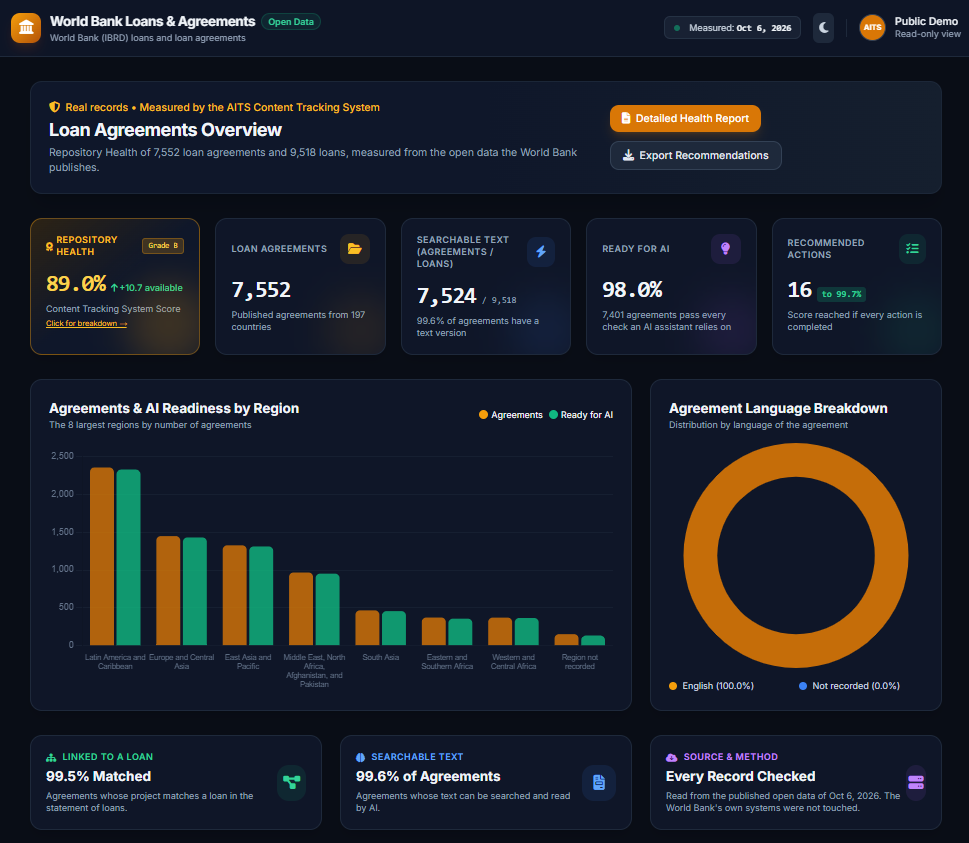
CTS measured on the World Bank's public loans
AITS pointed CTS at two sets of public World Bank records, its statement of loans and the loan agreements it publishes, and checked every loan and agreement, including how well the two agree. Seven of the eight dimensions were measured; security was left out because the records are public.
Measured from the published loan records and agreement details, not the World Bank's internal systems, against KPIs AITS chose for this presentation; the World Bank would choose its own. Nothing was edited. Not endorsed by, or connected with, the World Bank.
What a Healthy Repository Enables
Lending AI assistants you can trust
An AI assistant that answers questions about a loan is only as reliable as the documents it reads. With a current health score you know which portfolios are ready for AI assistants today.
- Document classification
- Term and clause extraction
- Loan file completeness review
- Loan-to-document reconciliation
- Duplicate and anomaly identification
- Amendment and version comparison
- Audit and due diligence preparation
- Portfolio search assistance
- Staff knowledge assistance
Questions and Answers
Lending: Questions and Answers
What is a Repository Health Check for a lender?
It is an assessment of the lending document repository: the agreements, their amendments, the details recorded for each one, and the link between every document and the loan it belongs to. AITS carries it out with the Content Tracking System (CTS), using AI trained on your own loan files. The result is one composite Repository Health score, the breakdown behind it, and a prioritized list of what to fix first.
What does CTS measure in a lending repository?
CTS scores the repository across eight dimensions: content, structure, metadata, search, data quality, security, governance and AI readiness. Each is built from KPIs the lender defines and weights. For example, whether every loan has its agreement on file, and whether the agreement and the loan record agree on country, loan number and dates.
How is this different from a loan file review?
A file review samples a few hundred loans a year. CTS checks every loan and every document as it is added, and compares the document repository with the loan records, so the answer does not depend on which loans a reviewer happens to pick.
Why does it matter to auditors, regulators and loan buyers?
A loan is only as enforceable as the documents behind it, and auditors, regulators and buyers of loans all ask to see the file. The score, the breakdown behind it and the list of issues are evidence you can show a board, an auditor or a regulator.
Can I see CTS measured on real loan records?
Yes. AITS pointed CTS at two sets of public records from the World Bank: its statement of loans and the loan agreements it publishes. Every loan and every agreement was checked, and the two sets were compared. The demo is not endorsed by, or connected with, the World Bank.
A loan book you can show is sound
Arrange an executive briefing or a Repository Health Check, or estimate your score in five minutes.