
Home/Solutions/National Archives
Public Sector: National Archives
Know the health of the public record
CTS gives an archive one Repository Health score for its catalogue: the descriptions, the hierarchy that gives every record its context, the digital copies and the access decisions. You do not have to imagine it: here it is, measured on real records.
The Question
Do you know the condition of what you hold?
Holdings were described over generations, to different standards, by different hands. Digitization adds images faster than descriptions can keep up. Problems surface one at a time: a researcher who cannot find a file, a digitized record nobody can search.
If you pulled a thousand catalogue records at random, what percentage would have a meaningful title, a date, a description, a complete place in the hierarchy and a recorded access status?
For example: a file unit whose title is only a number, a digitized record with no searchable text, or an item whose dates fall outside the dates of its own series. CTS flags it, scores its effect and recommends action, before a researcher or an AI assistant fails to find the record.
Why It Matters
The catalogue is the only way in
A record is only as usable as its description, and a gap in the catalogue is invisible to everyone searching it.
Permanent
Nothing ages out. A record described poorly today stays hard to find for as long as it is kept, which is forever.
Public
A record that cannot be found through its description might as well not be held.
Trusted
Courts, historians, journalists and citizens rely on the record being authentic, in context and correctly identified.
What CTS Measures
What CTS measures in an archive's repository
Each dimension is built from KPIs the archive defines and weights, and each rolls up into one composite score. How CTS works: it runs on a replica, never on the official repository, and it learns from your staff under their control.
Content
Does every record have a title of its own within its parent, and is its physical form stated?
Structure
Does every record sit in a complete hierarchy, up to its record group, at a recognized level?
Metadata
Are the required fields complete, and are the dates valid and in order?
Search
Is the title meaningful, is there a description or subject terms, and does a digitized record have searchable text?
Data Quality
Do a record's dates fall within those of its parent, and does each digital copy have its address, type and size recorded?
Security
Do access permissions reflect the sensitivity of the record, including restricted and closed material?
Governance
Are access and use status recorded, and is the custodian named?
AI Readiness
Does the record pass every check an AI assistant relies on to find it and describe it correctly?
See It on Real Records
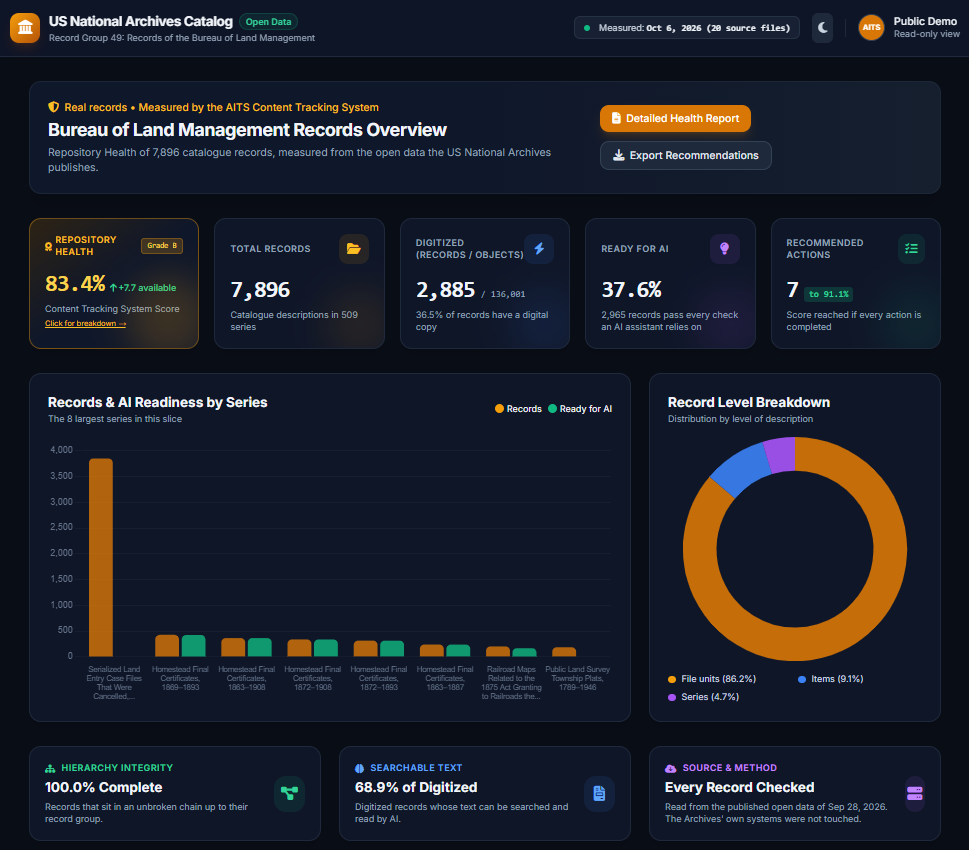
CTS measured on US National Archives open data
AITS pointed CTS at catalogue descriptions the US National Archives publishes as open data, checked every one against a set of KPIs, and rolled the results into one composite score. Seven of the eight dimensions were measured; security was left out because the collection is already public.
Measured from the published catalogue descriptions, not the documents themselves, against KPIs AITS chose for this presentation; the National Archives would choose its own. Nothing was edited. Not endorsed by, or connected with, the US National Archives.
What a Healthy Repository Enables
Archival AI assistants you can trust
AI assistants and AI search are only as reliable as the descriptions they work from. With a current health score you know which collections are ready for AI assistants today and which need work first.
- Natural-language catalogue search
- Document classification
- Information extraction
- Handwritten record transcription
- Description drafting for the backlog
- Duplicate and anomaly identification
- Record linkage across series
- Reference request assistance
- Staff knowledge assistance
Questions and Answers
Archives: Questions and Answers
What is a Repository Health Check for an archive?
It is an assessment of an archive's holdings and catalogue: the descriptions, the hierarchy that gives every record its context, the digital copies and the access decisions recorded against them. AITS carries it out with the Content Tracking System (CTS), using AI trained on the archive's own holdings. The result is one composite Repository Health score, the breakdown behind it, and a prioritized list of what to fix first.
What does CTS measure in an archive's repository?
CTS scores the repository across eight dimensions: content, structure, metadata, search, data quality, security, governance and AI readiness. Each is built from KPIs the archive defines and weights. Search, for example, asks whether the title is meaningful, whether there is a description or subject terms, and whether a digitized record has searchable text.
Why does catalogue quality matter for AI assistants and AI search?
AI search and AI assistants are only as reliable as the descriptions they work from. A record that cannot be found through its description might as well not be held, and a gap in the catalogue is invisible to everyone searching it.
Can I see CTS measured on real archival records?
Yes. AITS pointed CTS at catalogue descriptions the US National Archives publishes as open data and checked every one against a set of KPIs. The CTS Dashboard and the Health Report on this site show the result. The demo is not endorsed by, or connected with, the US National Archives.
Does CTS touch the archive's official repository?
No. CTS runs on a replica of the repository in a secure cloud environment hosted in-country. Corrections are made and checked in the replica first, and applying them to the official repository remains the archive's decision.
An archive you can show is sound
Arrange an executive briefing or a Repository Health Check, or estimate your score in five minutes.