
Home/Solutions/Human Resources
Private Sector: Human Resources
Know the health of your employee records
CTS gives HR one Repository Health score for the contracts, acknowledgements, certifications and sensitive records behind every employee, the breakdown behind it, and a prioritized list of what to fix first.
The Question
Do you know what is in your employee files?
Employee records sit across an HR system, shared drives, email, scanned paper and the systems of acquired companies. Problems surface one at a time: an audit, a dispute, an access request, a privacy complaint. A document never collected cannot be recovered afterwards.
If you pulled a thousand employee files at random, what percentage would be complete, current, correctly secured and within their retention period?
For example: an employee file missing a signed policy acknowledgement, or a medical record stored where too many people can see it. CTS flags it, scores its effect and recommends action, before the issue becomes a complaint or a claim.
Why It Matters
The employee file is a system of record
Every employment decision leaves a document. If the file is incomplete, out of date or open to the wrong people, the organization is exposed whether or not anyone has noticed.
Keeping too little is penalized
Employment standards, eligibility and health and safety rules require specific records. A missing record is itself a breach.
Keeping too much is a liability
Records held past their retention period, or seen by people who should not see them, are a privacy exposure.
Disputes turn on documents
In a grievance, a claim or an investigation, the employer's position is only as strong as the file.
What CTS Measures
What CTS measures in an HR repository
Each dimension is built from KPIs the organization defines and weights, and each rolls up into one composite score. How CTS works: it runs on a replica, never on the official repository, and it learns from your staff under their control.
Completeness
Does every employee file hold the documents its role, location and employment type require?
Metadata Quality
Are employee identifiers, document types, dates and signatures present, valid and consistent across systems?
Compliance
Do holdings meet employment standards, eligibility, health and safety, and privacy requirements in each jurisdiction?
Retention
Is each record class held for its required period and no longer, with legal holds honoured?
Security
Do access permissions separate medical, disciplinary and investigation records from the general file?
Governance
Does every collection have an owner, a classification and a recorded source?
Currency
Can the current contract, policy acknowledgement or certification be told apart from superseded or expired ones?
Duplication
Where the same document exists more than once, is the authoritative copy identified?
See It
See a human resources dashboard
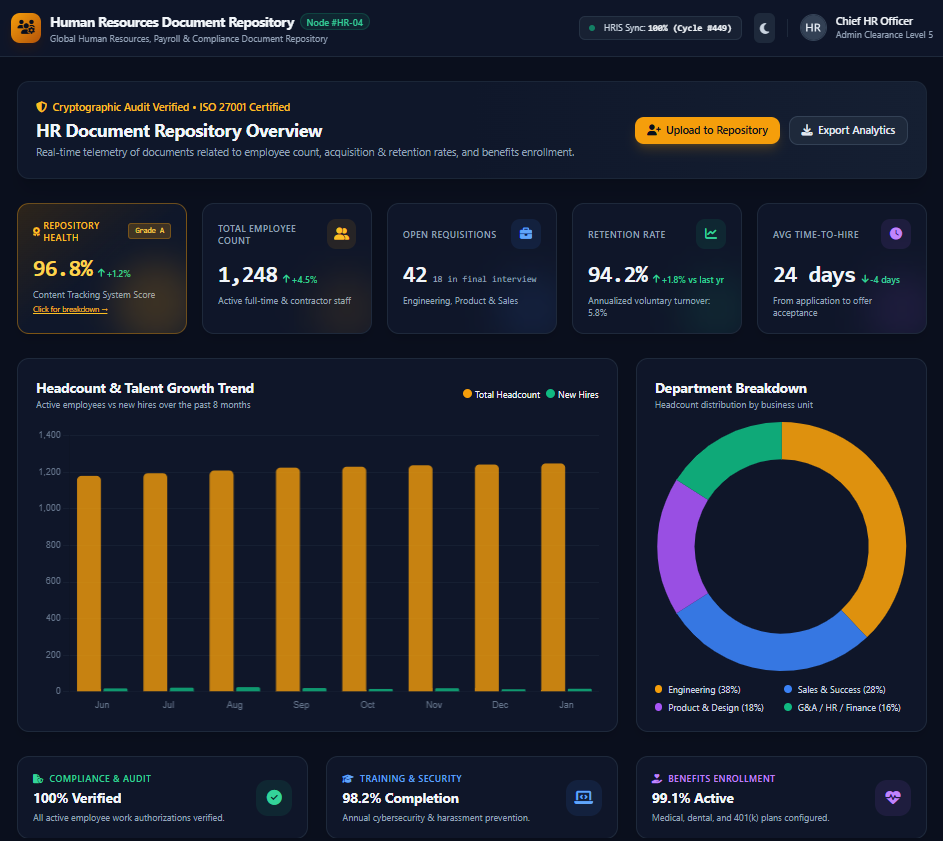
The illustrative dashboard shows the Repository Health score for an HR document repository. Click the score to see what it is made of and what to fix first.
What a Healthy Repository Enables
HR AI assistants you can trust
In HR, a wrong answer can expose a person's private record or decide a dispute on the wrong document. With a current health score you know which collections are ready for AI assistants today.
- Document classification
- Information extraction
- Contract and policy comparison
- Employee record search assistance
- Duplicate and anomaly identification
- Metadata enrichment
- Retention and legal hold screening
- Workforce reporting
- Staff knowledge assistance
Questions and Answers
HR Records: Questions and Answers
What is a Repository Health Check for HR records?
It is an assessment of the employee records an organization holds across its HR system, shared drives, email, scanned paper and the systems of companies it acquired. AITS carries it out with the Content Tracking System (CTS), using AI trained on your own records. The result is one composite Repository Health score, the breakdown behind it, and a prioritized list of what to fix first.
What does CTS measure in an HR repository?
CTS scores the repository across eight dimensions: completeness, metadata quality, compliance, retention, security, governance, currency and duplication. Each is built from KPIs the organization defines and weights. Completeness, for example, asks whether every employee file holds the documents its role, location and employment type require.
Why does the health of employee records matter?
The employee file is held to three tests. Keeping too little is penalized, because a missing required record is itself a breach. Keeping too much is a privacy liability. And in a grievance, a claim or an investigation, the employer's position is only as strong as the file.
How are sensitive HR records protected?
The Security dimension checks that access permissions separate medical, disciplinary and investigation records from the general file. CTS itself runs on a replica of the repository in a secure cloud environment hosted in-country, and the official repository is never touched.
Can it cover paper files and records from acquired companies?
Yes. Paper personnel files can be digitized, and records from legacy and acquired systems brought together, starting with the files the health check shows to be most at risk. CTS scores every record as it enters the repository, so you know the work is complete, legible and correctly filed.
Employee records you can show are sound
Arrange an executive briefing or a Repository Health Check, or estimate your score in five minutes.