
Home/Solutions/Vital Events Registry
Public Sector: Vital Events Registry
Know the health of the records behind every identity
CTS gives the registry one Repository Health score for the registrations, amendments and indexes every certificate is issued from, the breakdown behind it, and a prioritized list of what to fix first.
The Question
Do you know what your registry rests on?
Registrations span generations of handwritten registers, paper, film, fiche, scanned images and electronic filings. Problems surface one at a time: a certificate that cannot be issued, a record that cannot be found, an identity that cannot be confirmed.
If you pulled a thousand registrations at random, what percentage would be complete, legible, correctly indexed and linked to the amendments that changed them?
For example: a birth registration whose image exists but whose index record is incomplete, or an amendment that is not linked to the registration it changes. CTS flags it, scores its effect and recommends action, before the issue becomes a wrong certificate.
Why It Matters
A registration is the legal foundation of an identity
An error in the record does not stay in the registry. It follows the person into every service that relies on it.
Foundational
Passports, health coverage, pensions and benefits are issued on the strength of a birth registration.
Permanent
A birth registered ninety years ago may be requested tomorrow to settle a pension. Nothing ages out.
Protected
Adoptions, sealed registrations and personal information must stay restricted to those entitled to see them.
What CTS Measures
What CTS measures in a vital events repository
Each dimension is built from KPIs the registry defines and weights, and each rolls up into one composite score. How CTS works: it runs on a replica, never on the official repository, and it learns from your staff under their control.
Completeness
Does every registered event have its registration image, its index record and its supporting documents?
Metadata Quality
Are names, dates, places and registration numbers present, valid and consistent across eras?
Compliance
Do holdings meet the vital statistics statute, the registrar's directions, and privacy and records legislation?
Retention
Is each record class held for its required period, and is transfer to the archives recorded when it happens?
Security
Do access permissions reflect the sensitivity of the record, including adoptions and sealed registrations?
Governance
Does every collection have an owner, a classification and a recorded source?
Currency
Can the current registration be told apart from one that an amendment, correction or adoption has superseded?
Duplication
Where the same event is recorded more than once, is the authoritative registration identified?
See It
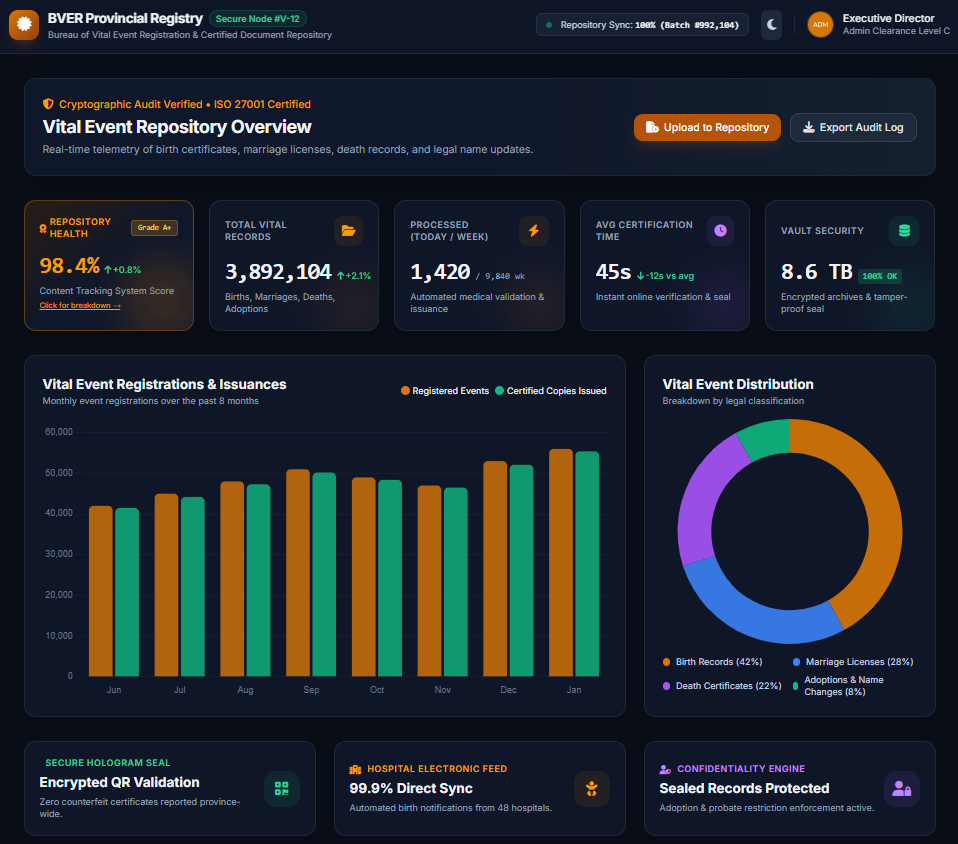
See a vital events registry dashboard
The illustrative dashboard shows the Repository Health score for a vital events registry. Click the score to see what it is made of and what to fix first.
What a Healthy Repository Enables
Registry AI assistants you can trust
In a registry, a wrong answer can be a wrong answer about who a person is. With a current health score you know which collections are ready for AI assistants today and which need work first.
- Document classification
- Information extraction
- Handwritten register interpretation
- Record discovery and search assistance
- Duplicate and anomaly identification
- Record linkage across life events
- Amendment and record comparison
- Registration review assistance
- Staff knowledge assistance
Questions and Answers
Vital Events Registry: Questions and Answers
What is a Repository Health Check for a vital events registry?
It is an assessment of the repository behind every certificate: the registrations, amendments, indexes and supporting documents. AITS carries it out with the Content Tracking System (CTS), using AI trained on the registry's own records. The result is one composite Repository Health score, the breakdown behind it, and a prioritized list of what to fix first.
What does CTS measure in a vital events repository?
CTS scores the repository across eight dimensions: completeness, metadata quality, compliance, retention, security, governance, currency and duplication. Each is built from KPIs the registry defines and weights. Completeness, for example, asks whether every registered event has its registration image, its index record and its supporting documents.
Why does repository health matter for birth, death and marriage records?
A vital event registration is the legal foundation of a person's identity. Passports, health coverage, pensions and benefits are issued on the strength of it, and a birth registered ninety years ago may be requested tomorrow. An error in the record follows the person into every service that relies on it.
How are adoptions and sealed registrations protected?
The Security dimension checks that access permissions reflect the sensitivity of each record, including adoptions and sealed registrations. CTS itself runs on a replica of the repository in a secure cloud environment hosted in-country, and the official repository is never touched.
How does a health check support digitization of legacy registers?
Digitization can start with the records the health check shows to be most at risk. CTS scores every digitized record as it enters the repository, so the registry knows the work is complete, legible and correctly indexed before the originals are retired.
A registry you can show is sound
Arrange an executive briefing or a Repository Health Check, or estimate your score in five minutes.