
Home/Solutions/Land Titles Registry
Public Sector: Land Titles Registry
Know the health of the records behind your register
CTS gives the registry one Repository Health score for the instruments, plans and indexes the register is built from, the breakdown behind it, and a prioritized list of what to fix first. It is evidence you can show a minister or an auditor.
The Question
Do you know what your register rests on?
Most registries cannot say. Decades of instruments sit across paper, film, fiche and scanned images, and those media deteriorate. Problems surface one at a time: a failed search, a disputed title, a claim for compensation. A record that has deteriorated beyond recovery cannot be fixed afterwards.
If you pulled a thousand instruments at random from those referenced on current titles, what percentage would be complete, legible and correctly indexed?
For example: an easement referenced on a live title whose scanned instrument is illegible, or a plan indexed to the wrong parcel. CTS flags it, scores its effect on repository health and recommends action, before the issue becomes a claim.
Why It Matters
Under Torrens, the register is the title
The register is conclusive, which is exactly why what stands behind it must be sound. Each principle rests on the registry's repository.
Mirror
The register reflects the current state of every title, accurately and completely.
Curtain
Anyone dealing with land may rely on the register without investigating what lies behind it.
Insurance
The state stands behind the register and compensates those who suffer a loss because of an error in it.
What CTS Measures
What CTS measures in a land titles repository
Each dimension is built from KPIs the registry defines and weights, and each rolls up into one composite score. How CTS works: it runs on a replica, never on the official repository, and it learns from your staff under their control.
Completeness
Does every registered instrument have its image, its index record and its supporting documents?
Metadata Quality
Are instrument numbers, parcel identifiers, party names and dates present, valid and consistent across eras?
Compliance
Do holdings meet the registration statute, the registrar's directions and records legislation?
Retention
Is each record class held for its required period, and is disposition recorded where it is permitted?
Security
Do access permissions match the sensitivity of the record and the role of the user?
Governance
Does every collection have an owner, a classification and a recorded source?
Currency
Can the current instrument be told apart from superseded, discharged or cancelled ones?
Duplication
Where the same instrument exists more than once, is the authoritative copy identified?
See It
See a land titles registry dashboard
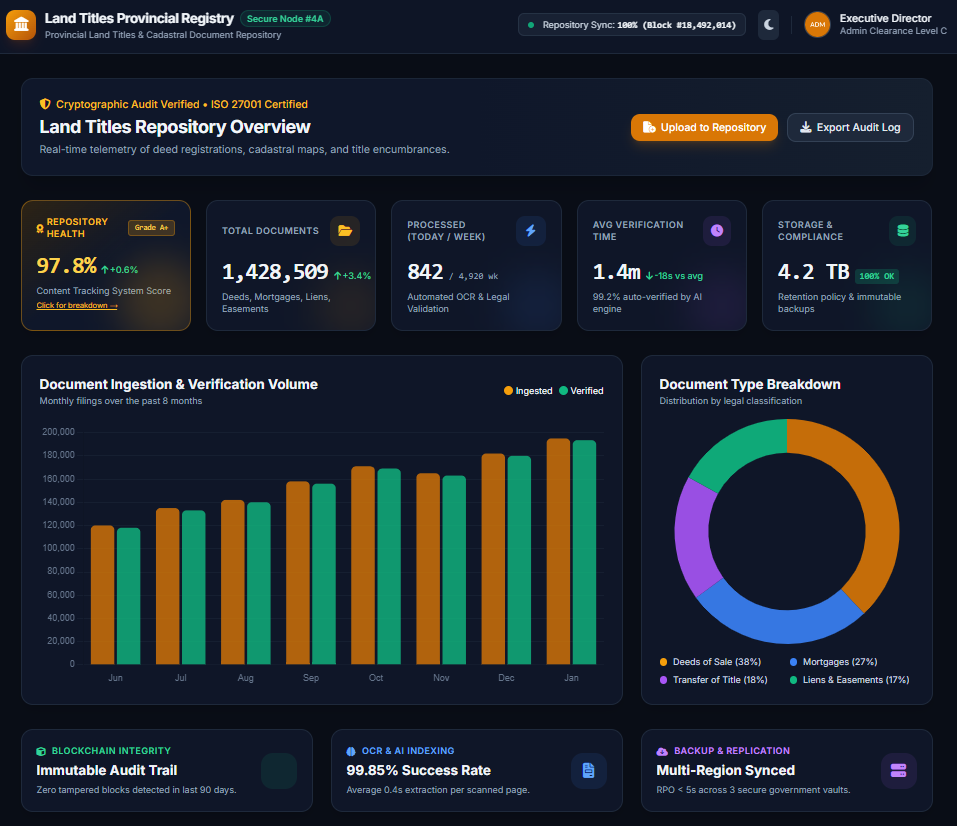
The illustrative dashboard shows the Repository Health score for a land titles registry. Click the score to see what it is made of and what to fix first.
What a Healthy Repository Enables
Registry AI assistants you can trust
In a registry, a wrong answer can be a wrong answer about who owns land. With a current health score you know which collections are ready for AI assistants today and which need work first.
- Document classification
- Information extraction
- OCR and historical record interpretation
- Record discovery and search assistance
- Duplicate and anomaly identification
- Metadata enrichment
- Amendment and record comparison
- Examination assistance
- Staff knowledge assistance
Questions and Answers
Land Titles Registry: Questions and Answers
What is a Repository Health Check for a land titles registry?
It is an assessment of the document repository behind the register: the instruments, plans, indexes and data from which the register is built. AITS carries it out with the Content Tracking System (CTS), using AI trained on the registry's own records. The result is one composite Repository Health score, the breakdown behind it, and a prioritized list of what to fix first.
What does CTS measure in a land titles repository?
CTS scores the repository across eight dimensions: completeness, metadata quality, compliance, retention, security, governance, currency and duplication. Each is built from KPIs the registry defines and weights. Completeness, for example, asks whether every registered instrument has its image, its index record and its supporting documents.
Why does repository health matter under the Torrens system?
Under Torrens the register is the title, and the state stands behind it. The register is built from the instruments, plans and indexes in the repository, so an illegible instrument or a plan indexed to the wrong parcel is an error the registry is answerable for. A health check finds those records before they become a claim.
How does a health check support registry modernization and digitization?
Digitization can start with the records the health check shows to be most at risk. CTS scores every digitized record as it enters the repository, so the registry knows the work is complete, legible and correctly indexed before the originals are retired. That measurement is independent of whoever performs the digitization.
Does CTS touch the official register or its repository?
No. CTS runs on a replica of the repository in a secure cloud environment hosted in-country. Corrections are made and checked in the replica first, and applying them to the official repository remains the registry's decision.
A register you can show is sound
Arrange an executive briefing or a Repository Health Check, or estimate your score in five minutes.